By Amiti Grozdon, M.Ed., LPC, LCPC, LCMHC. Licensed in Texas, Maine, Montana and New Hampshire. Last reviewed November 28, 2026.

Amiti Grozdon, LPC, offers online therapy for partners of people with ADHD, with or without a formal diagnosis. Start with a free 15-minute consultation.
The short answer
If you keep asking "Is it ADHD, or is it me?", you're probably worn out from trying to make sense of patterns that don't respond to the usual fixes. Often the honest answer is "some of both." ADHD can shape how your partner handles time, memory, attention and emotions, and the way the two of you respond to that can harden into a cycle. Neither of you is the whole problem. You can't diagnose your partner from the outside, but you can understand the pattern and get help with it.
Why partners start asking this question
About 6% of U.S. adults have a current ADHD diagnosis, and more than half of them were diagnosed as adults (CDC, 2024). Many couples live with ADHD patterns for years before anyone names them. In the meantime, the non-ADHD partner often fills the gaps and starts to wonder whether they're too demanding, too sensitive or "nagging."
Moments that often bring the question up:
- You've explained the same thing many times, and it still doesn't stick.
- Your partner means it when they agree, and then it doesn't happen.
- You hear "You're overreacting" more often than "I'm sorry."
- You carry most of the planning, remembering and follow-through.
- You feel lonely in the relationship, even though your partner loves you.
Questions partners often ask
"Does my partner just not care?"
Usually caring isn't the issue. ADHD affects executive functions like starting tasks, holding information in mind and tracking time, so the gap between meaning to do something and doing it can be wide. That gap still affects you, and it's fair to say so. Understanding the cause changes how you solve it, not whether it matters. Read more about the intention-action gap.
"Am I nagging, or am I asking for something reasonable?"
Both can be true. Reminding is a reasonable response to things that keep slipping, and it can still turn into a role neither of you wants, where one partner manages and the other feels managed. Many couples describe this as a parent-child dynamic. The fix is usually shared systems, not more reminders.
"Is it ADHD, or is it their personality?"
ADHD is part of how someone's brain works, and it mixes with personality, stress, sleep, other conditions and history. You don't need to sort every trait into a box. A more useful question is which patterns respond to structure and support, and which are about values, respect or willingness to try.
"Am I too sensitive?"
Feeling hurt by missed plans, forgotten conversations or being interrupted is a normal reaction. Your partner may also be dealing with strong emotional reactions of their own, including rejection sensitivity, which can make feedback feel like an attack. Both of your feelings can be real at once.
"Could I be the one with ADHD?"
Sometimes the question turns around. Some people read about a partner's ADHD and recognize themselves too. If that happens, a professional evaluation is the way to find out. Other partners notice that anxiety or burnout has grown from years of over-functioning. That deserves care too.
"Is it ADHD, or is it something more serious?"
ADHD can explain forgetting, distraction and impulsive reactions. It doesn't explain or excuse control, threats, intimidation or a steady refusal to take any responsibility. If you feel afraid of your partner, that isn't an ADHD issue to work around. The National Domestic Violence Hotline (1-800-799-7233, or text START to 88788) can help you think through safety.
What isn't your fault, and what's yours to work on
You didn't cause your partner's ADHD, and you can't fix it by explaining better or trying harder. You also don't have to be the household's memory forever.
What you can work on is your side of the cycle. Couples researcher John Gottman describes how criticism tends to bring out defensiveness, which brings out more criticism. In ADHD relationships, that often looks like a frustrated reminder, a defensive reply, and both people pulling away. Seeing your part in that loop isn't taking the blame. It gives you something you can change.
Work on follow-through, conflict and the parent-child pattern together, online.
What helps
- Name the pattern together. "We keep getting stuck on follow-through" lands better than "You never do anything."
- Build memory outside your head. Shared calendars, checklists and visible reminders take the job off your shoulders.
- Divide work by strengths. Give each person tasks that fit how they work, and agree on what "done" means. See sharing household responsibilities.
- Talk when you're both calm. Hard conversations go better when neither of you is flooded.
- Make room for both experiences. Your partner's effort is real, and so is your exhaustion.
- Get support for yourself. Many non-ADHD partners feel unseen. Read about the non-ADHD partner's experience and loneliness in neurodiverse relationships.
When to get help
Consider couples therapy if the same arguments keep repeating, resentment keeps growing, or one of you feels more like a parent or a project than a partner. If your partner isn't ready, individual therapy can help you sort out what's yours, what isn't and what you want. If you suspect ADHD but aren't sure, read what to do when you suspect ADHD or autism in your relationship.
Support for partners at Sagebrush Counseling
Amiti Grozdon, M.Ed., offers online ADHD couples therapy and therapy for neurotypical partners in Texas, Maine, Montana and New Hampshire. Your partner doesn't need a diagnosis to start. Begin with a free 15-minute consultation through the contact page, and see fees and services.
Frequently asked questions
How do I know if my partner has ADHD?
You can't know for sure from the outside. Patterns like chronic lateness, forgotten agreements, losing things and acting on impulse can point toward ADHD, but only a qualified professional can evaluate it.
Can I make my partner get tested for ADHD?
No. You can share what you've noticed and how it affects you, and invite them to look into it. Pressure tends to backfire, while curiosity tends to help.
Is it normal to feel resentful toward a partner with ADHD?
Yes. Resentment often builds when one partner carries more of the load for a long time. It's a sign that something needs to change, not proof that you're a bad partner.
Does ADHD excuse hurtful behavior?
No. ADHD can explain why some things are hard, but each partner is still responsible for the impact of what they do and for working on it.
Can couples therapy help if only one of us thinks ADHD is the issue?
Often, yes. Therapy can focus on the patterns you both feel, like conflict, follow-through and not feeling heard, without needing you to agree on a label first.
Sources
- Staley, B. S., Robinson, L. R., Claussen, A. H., and others (2024). Attention-deficit/hyperactivity disorder diagnosis, treatment, and telehealth use in adults: National Center for Health Statistics Rapid Surveys System, United States, October to November 2023. MMWR, 73(40), 890 to 895.
- Gottman, J. M., and Silver, N. (2015). The Seven Principles for Making Marriage Work (revised edition). Harmony.
- Orlov, M. (2010). The ADHD Effect on Marriage. Specialty Press.
Workbooks for couples
Instant downloads you can print at home.
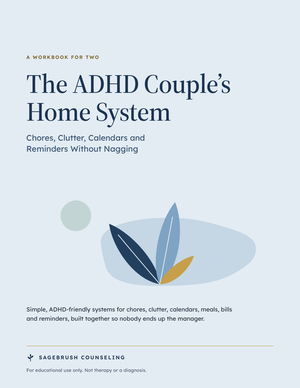
The ADHD Couple's Home System
ADHD-friendly systems for chores, calendars, meals and bills, built together so nobody ends up the manager.
Get the download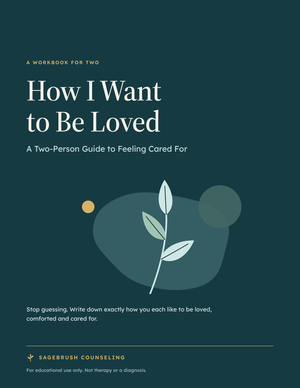
How I Want to Be Loved
Write down exactly how you each like to be loved, so neither of you has to guess.
Get the download
Draw a Card, Write a Page: 100 Journal Prompt Cards
100 prompts to help you slow down and notice what you feel, five minutes at a time.
Get the downloadYou don't have to figure this out alone
Online therapy for individuals and couples in Texas, Maine, Montana and New Hampshire. Start with a free 15-minute consultation. See current fees.
Book a free consultationEducational information, not advice. This article is for general education. Nothing here is medical or mental health advice, a diagnosis, or a recommendation about what's right for you, and reading it doesn't create a therapist and client relationship. If you're in crisis or thinking about suicide, call or text 988, the Suicide and Crisis Lifeline. If you're in danger, call 911.