By Amiti Grozdon, M.Ed., LPC, LCPC, LCMHC. Licensed in Texas, Maine, Montana and New Hampshire. Last reviewed November 28, 2026.

Amiti Grozdon, LPC, helps ADHD couples share the load in a way that works for both of you. Start with a free 15-minute consultation.
The short answer
Weaponized incompetence means doing a task badly, or claiming you can't do it, so someone else takes it over. ADHD is different: the person wants to follow through, but executive function problems get in the way. From the outside, both can look the same: the dishes still aren't done. The difference shows up over time in how your partner responds when you name the problem, whether they take ownership, and whether they use support once it's there. And in some couples, it's a mix of both.
What weaponized incompetence looks like
The term caught on online to describe a familiar pattern: one partner "can't" load the dishwasher right, "doesn't know" the kids' schedule, or does a job so poorly that the other partner gives up and does it themselves. The key feature is that it pays off. The task moves to someone else, and the person avoiding it doesn't have to change.
Signs that lean toward weaponized incompetence:
- The same person handles complex tasks well at work or in hobbies, but can't manage simple ones at home that they don't enjoy.
- Asking for help or showing them how doesn't change anything, and they don't seem interested in changing it.
- Mistakes come with "Well, you do it better" or "Then do it yourself."
- They dismiss the impact on you, or treat your frustration as the problem.
- Nothing changes even after a calm, specific conversation about what you need.
What ADHD can look like
ADHD affects executive functions: starting tasks, remembering steps, holding a plan in mind, judging time and switching attention. Psychologist Russell Barkley describes ADHD as a problem of doing what you know, not of knowing what to do. That can create the same outcome as weaponized incompetence, with a very different inner experience.
Signs that lean toward ADHD:
- Your partner means to do it, then forgets, gets pulled away or underestimates how long it takes.
- Tasks that are boring, multi-step or open-ended are the hardest, even when the stakes are high for them too.
- They feel genuine shame or frustration about the pattern, not relief.
- Struggles show up across life, not only with tasks they'd rather avoid: bills, appointments, their own paperwork.
- External supports like checklists, timers, body doubling and shared calendars actually help when they use them.
Why it's hard to tell
ADHD attention is driven by interest and urgency, so someone with ADHD can hyperfocus on a hobby for hours and still be unable to start the laundry. That can look selective, even when it isn't deliberate. And someone with ADHD can still lean on their partner in unfair ways, especially after years of a partner stepping in. Both things can be true at once.
It also helps to know that household work includes a thinking part: noticing what needs doing, planning and keeping track. Sociologist Allison Daminger found that this cognitive work tends to fall unevenly between partners. In ADHD relationships, it often lands almost entirely on the non-ADHD partner, which you can read more about in invisible labor in neurodiverse relationships.
The question that matters most
Instead of "Is it ADHD or is it on purpose?", try asking: "When the impact is clear, does my partner take ownership and try something different?"
A partner with ADHD who cares about the relationship might still forget, but they'll usually engage with solutions, accept reminders without contempt and keep trying. A partner who uses incompetence as a shield tends to resist any system, minimize your experience and leave the work where it is. ADHD can explain why something is hard. It doesn't remove responsibility for working on it.
What helps
- Talk about one task at a time. "Can we figure out a way for the kids' lunches to get packed without me tracking it?" works better than a list of everything.
- Hand over whole jobs, not steps. Owning a task from noticing to finishing is fairer than doing what you're told. Agree together on what "done" looks like.
- Build systems that don't depend on memory. Visible checklists, recurring reminders and set times work better than willpower. See chore charts for adults with ADHD.
- Stop rescuing when it's safe to. If you always step in, the task stays yours. Letting something stay undone for a while can be uncomfortable, but it makes the pattern visible.
- Notice your own tone. Contempt and constant correction make anyone less likely to engage. That isn't about blaming you. It's about what gets results.
- Revisit it regularly. A short weekly check-in about what's working keeps resentment from building.
If chores have turned into the main battleground, the chores quiz can help you see whether you're fighting about tasks or about something underneath them.
When to get help
Couples therapy can help when the same fight keeps repeating, when one partner feels like a parent, or when you can't tell anymore whether your partner is struggling or checked out. A therapist who understands ADHD can help you sort out what's executive function, what's habit and what's about the relationship. If you suspect your partner has ADHD, an evaluation is the way to find out.
Work on follow-through, fairness and the parent-child pattern together, online.
ADHD couples therapy at Sagebrush Counseling
Amiti Grozdon, M.Ed., offers online ADHD couples therapy and therapy for neurotypical partners in Texas, Maine, Montana and New Hampshire. A diagnosis isn't required to start. Begin with a free 15-minute consultation through the contact page, and see fees and services.
Frequently asked questions
Is weaponized incompetence a real thing?
It isn't a clinical term, but the pattern it describes is real: avoiding a task by doing it badly or claiming you can't, so someone else takes it on.
Can someone with ADHD use weaponized incompetence?
Yes. ADHD and avoidance can overlap. Having ADHD doesn't mean every missed task is ADHD, and it doesn't mean every missed task is deliberate either.
How do I bring this up without starting a fight?
Pick a calm time, focus on one task, describe the impact on you, and ask your partner to help solve it. Avoid labels like "lazy" or "weaponized," which tend to end the conversation.
Why can my partner focus on hobbies but not chores?
ADHD attention follows interest and urgency. Activities that are engaging can hold attention for hours, while boring or open-ended tasks are much harder to start.
Will couples therapy help if my partner thinks I'm the problem?
It often does. Therapy can look at the pattern between you, so neither person has to be the villain for things to change.
Sources
- Barkley, R. A. (2021). Taking Charge of Adult ADHD (2nd ed.). Guilford Press.
- Daminger, A. (2019). The cognitive dimension of household labor. American Sociological Review, 84(4), 609 to 633.
Workbooks for couples
Instant downloads you can print at home.
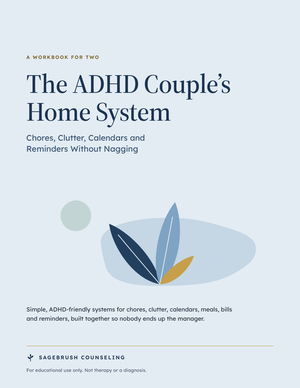
The ADHD Couple's Home System
ADHD-friendly systems for chores, calendars, meals and bills, built together so nobody ends up the manager.
Get the download
How I Want to Be Loved
Write down exactly how you each like to be loved, so neither of you has to guess.
Get the download
250 Date Ideas for Couples
Free, low-cost and splurge dates for every week, plus simple ways to plan them.
Get the downloadGet unstuck together
Online therapy for couples and individuals in Texas, Maine, Montana and New Hampshire. Start with a free 15-minute consultation. See current fees.
Book a free consultationEducational information, not advice. This article is for general education. Nothing here is medical or mental health advice, a diagnosis, or a recommendation about what's right for you, and reading it doesn't create a therapist and client relationship. If you're in crisis or thinking about suicide, call or text 988, the Suicide and Crisis Lifeline. If you're in danger, call 911.