By Amiti Grozdon, M.Ed., LPC, LCPC, LCMHC. Licensed in Texas, Maine, Montana and New Hampshire. Last reviewed November 28, 2026.

Amiti Grozdon, LPC, helps ADHD couples step out of the parent-child pattern. Start with a free 15-minute consultation.
The short answer
When your husband has ADHD, what helps most is shared responsibility: he owns his ADHD and its treatment, you stop being his memory, and the two of you build systems that don't rely on either of you trying harder. What tends to backfire is constant reminding, taking over his tasks, and waiting for him to "just change." You can care about his struggles and still expect him to work on them.
What it often feels like
Many wives of men with ADHD describe the same things: feeling like a parent instead of a partner, carrying the planning and remembering, hearing promises that don't turn into action, and feeling lonely even though he loves them. If that's you, you're not imagining it, and you're not alone. You can read more about feeling alone in an ADHD marriage and spouse burnout.
It may help to know how common this is. About 6% of U.S. adults have a current ADHD diagnosis, and more than a third of them got no treatment for it in the past year (CDC, 2024). Many more adults have ADHD that's never been diagnosed.
What doesn't help
- Reminding him over and over. It works for a day, then becomes your job forever, and it slowly turns you into the manager of his life.
- Doing his tasks for him. Stepping in feels faster, but it keeps the load on you and the pattern in place.
- Waiting for willpower. ADHD isn't a motivation problem, so "trying harder" rarely lasts.
- Criticism and sarcasm. They're understandable after years of frustration, but they tend to trigger defensiveness or shutdown instead of change.
- Treating ADHD as an excuse. On the other side, it doesn't help when ADHD becomes the reason nothing can be expected.
What does help
He owns his ADHD
The most important shift is that your husband takes responsibility for understanding his ADHD and getting support for it. Treatment can include therapy, coaching and medication, and the choices are between him and his clinicians. Your role isn't to manage his treatment. It's fair to ask that he engage with it.
You step out of the parent role
Many couples fall into a parent-child dynamic, where one partner manages and the other feels managed. Stepping out means letting him own whole tasks, from noticing to finishing, and tolerating some imperfection while he builds systems.
Systems instead of memory
Psychologist Russell Barkley describes ADHD as a problem of doing what you know, not knowing what to do. That's why external supports work better than good intentions: shared calendars, checklists where he'll see them, timers, recurring reminders and set routines. See dividing labor in an ADHD marriage.
Clear, specific requests
"Can you take over the trash, including noticing when it's full?" works better than "You never help." Agree on what "done" means, and check in weekly instead of daily.
Room for his side
Many men with ADHD carry a lot of shame from years of being called lazy or careless. Some also react strongly to criticism, which can look like anger or withdrawal. Read more about rejection sensitivity in relationships. Understanding this doesn't mean accepting hurtful behavior. It means picking moments and words that give change a chance.
Time that isn't about problems
When every conversation is about logistics, the friendship fades. Protect some time that's just for fun or closeness, even if it's short.
Therapy for neurotypical partners, whether or not your husband joins.
What you're allowed to expect
ADHD can explain why things are hard. It doesn't excuse contempt, lying, or a steady refusal to try. It's reasonable to expect that your husband takes your experience seriously, works on his part, and treats you with respect when things go wrong. If you ever feel afraid of him, that isn't an ADHD problem to manage. The National Domestic Violence Hotline (1-800-799-7233, or text START to 88788) can help.
Taking care of yourself
Years of over-functioning can leave you burned out, resentful or unsure of what you want. Your own support matters, whether or not your husband is ready to change. Individual therapy can help you sort out your limits, your hopes for the marriage and what you need to feel like a partner again. If you've been wondering whether the problem is you, read Is it ADHD, or is it me?
ADHD couples therapy at Sagebrush Counseling
Amiti Grozdon, M.Ed., offers online ADHD couples therapy and therapy for neurotypical partners in Texas, Maine, Montana and New Hampshire. Your husband doesn't need a diagnosis for you to start. Begin with a free 15-minute consultation through the contact page, and see fees and services.
Frequently asked questions
Can a marriage survive when the husband has ADHD?
Yes. Many couples do well once ADHD is understood and both partners work on the patterns it creates. It usually takes effort from both people.
What if my husband won't admit he has ADHD?
You can't make him get evaluated. You can describe the patterns and their impact on you, and get support for yourself in the meantime.
Should I stop reminding him altogether?
Not overnight. It works better to agree together on systems that replace your reminders, then step back as those systems take hold.
Is it normal to feel resentful?
Yes. Resentment often signals that the load has been uneven for a long time. It's a reason to change the pattern, not proof you've failed.
Does he need medication?
That's a decision for him and his prescriber. Medication helps many adults with ADHD, and therapy and practical systems help too.
Sources
- Barkley, R. A. (2021). Taking Charge of Adult ADHD (2nd ed.). Guilford Press.
- Orlov, M. (2010). The ADHD Effect on Marriage. Specialty Press.
- Staley, B. S., Robinson, L. R., Claussen, A. H., and others (2024). Attention-deficit/hyperactivity disorder diagnosis, treatment, and telehealth use in adults. MMWR, 73(40), 890 to 895.
Workbooks for couples
Instant downloads you can print at home.
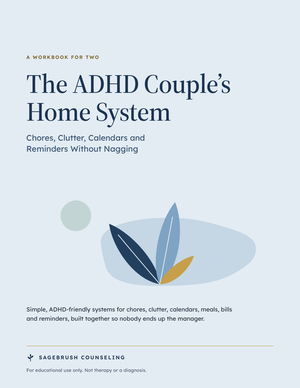
The ADHD Couple's Home System
ADHD-friendly systems for chores, calendars, meals and bills, built together so nobody ends up the manager.
Get the download
How I Want to Be Loved
Write down exactly how you each like to be loved, so neither of you has to guess.
Get the download
Draw a Card, Write a Page: 100 Journal Prompt Cards
100 prompts to help you slow down and notice what you feel, five minutes at a time.
Get the downloadYou deserve a partnership
Online therapy for couples and individuals in Texas, Maine, Montana and New Hampshire. Start with a free 15-minute consultation. See current fees.
Book a free consultationEducational information, not advice. This article is for general education. Nothing here is medical or mental health advice, a diagnosis, or a recommendation about what's right for you, and reading it doesn't create a therapist and client relationship. If you're in crisis or thinking about suicide, call or text 988, the Suicide and Crisis Lifeline. If you're in danger, call 911.